

 Michelle Thompson
Zeeshan Ali has been a drag performer for a decade, showcasing his acts across India.
A key element of his performance is his collection of nearly 45 wigs.
“Wigs help me transform into bold, glamorous, or playful personas. The right one enhances my authenticity and stage presence,” says Ali, who is based in Mumbai.
However, sourcing wigs was a challenge in the beginning.
“When I started, wigs were hard to find in India. I often had to import them or craft my own using materials like wool and fabric,” he explains.
Now, the landscape has shifted.
“Wigs are no longer exclusive to drag or film artists. Many women wear them for style, making them more than just a hairpiece—they’re now a fashion statement.”
India has long been a major player in the wig industry. The country supplies 85% of the global demand for human hair, making it the world’s top exporter.
Kolachi Venkatesh, based in Avadi, Chennai, has been in the hair collection business for two decades. He started as a picker, gathering hair from homes and even salvaging it from waste.
“My parents were hair pickers, and I followed in their footsteps,” he shares.
Hair collected from homes, salons, and barbershops—known as non-Remy hair—requires more processing than Remy hair, which is directly shaved from the scalp. However, it still holds value.
“People discard it, but it’s as good as gold,” says Venkatesh.
Pickers typically sell hair to local traders like him for $0.10 to $1 per kilogram, depending on quality and length.
Shorter or damaged strands are worth less, while longer ones fetch higher prices.
For individual pickers, earnings are modest.
“A dedicated collector might gather 1–5 kilograms daily, making between $0.59 and $6—often below minimum wage, especially in rural areas,” says Venkatesh, who employs 50 pickers.
“Despite our role in a billion-dollar industry, middlemen dictate prices, leaving us with minimal earnings.”
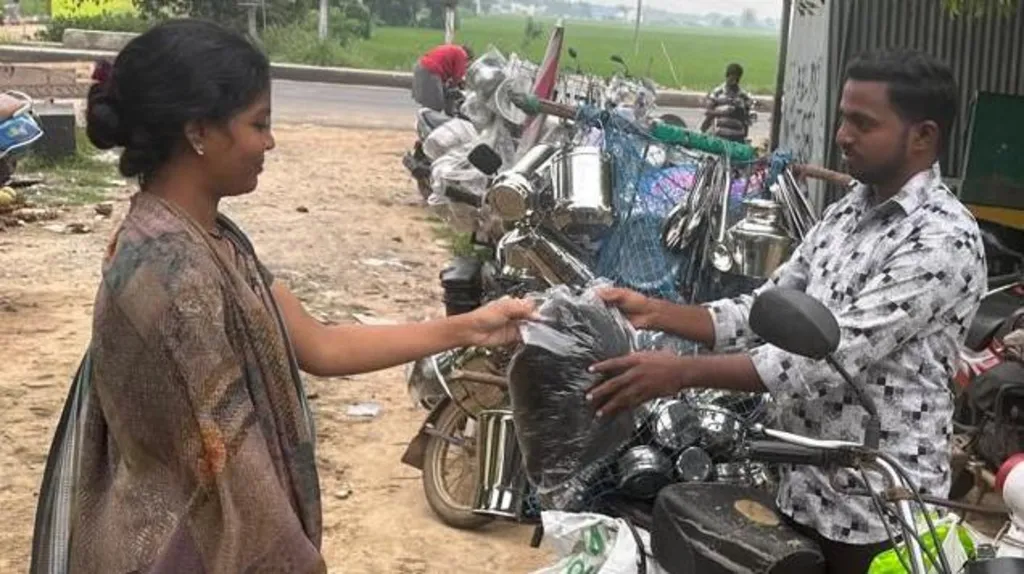
Kolachi Venkatesh has spent 20 years gathering hair.
Much of the Indian hair collected by traders like Venkatesh is sent to China, where it is used to create wigs.
“China has a massive wig industry worth around five to six billion dollars,” says Benjamin Cherian from Plexconcil, an industry body promoting India’s hair sector.
For India to tap into the lucrative wig market, he believes there’s significant ground to cover.
“China has hundreds of factories dedicated to enhancing the hair industry, while in India, the value addition is still underdeveloped,” Cherian explains.
He advocates for government support to boost investment in the industry.
“The sector needs automated sorting systems, advanced hair treatment processes, and innovative wig manufacturing techniques to make India stand out,” he adds.
Instead of just exporting hair for a few hundred dollars, Cherian argues that India should aim to sell high-value wigs worth thousands.
“We’re working on it, but there’s still a long way to go. We need research and training centers,” he concludes.

Diva Divine Hair has been manufacturing wigs and extensions since 2009.
Diva Divine Hair, a Delhi-based company co-founded by Nidhi Tiwari in 2009, is working to break into the market by producing high-quality wigs and extensions that cater to a wide range of customers.
“The demand for these products has grown due to increasing hair loss and thinning issues among women in India,” says Tiwari.
The company has benefitted from changing attitudes.
“Wigs and extensions, once a niche or taboo subject, are now openly discussed, thanks to shifting social norms and greater acceptance,” she explains.
Advancements in wig technology have also made them more appealing and comfortable.
“Technologies like 3D-printed wigs and digital color-matching tools offer personalized options. Lightweight, breathable wig caps and better adhesives allow customers to wear them for extended periods without discomfort,” Tiwari adds.
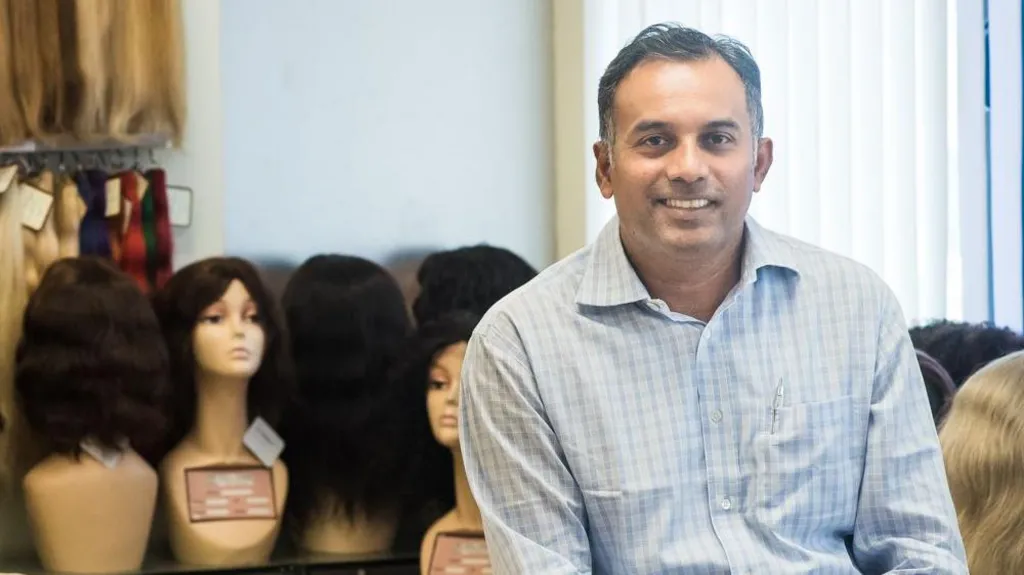
George Cherian says the demand for Indian hair is “skyrocketing.”
At the high end of the hair market is Temple or Remy hair, most of which is sourced from Hindu temples in southern India, where hair is shaved as an act of devotion.
Raj Hair International is a major player in the Temple hair trade.
In the company’s Chennai factory, skilled craftsmen sort and grade the hair based on its color, texture, and length.
“Remy hair has aligned cuticles, allowing it to flow in one direction. This results in less tangling and a silkier texture. It’s high-value hair,” explains George Cherian, the company’s CEO.
The company strives to minimize waste and has developed a machine to untangle hair, increasing efficiency with fewer staff.
“Our goal is to continually advance our technology,” says Cherian.
Business is thriving.
“Indian human hair is in high demand globally because of its quality, natural appearance, and thinness. The demand is skyrocketing,” he adds.
In Mumbai, Zeeshan Ali hopes to see more Indian wigs on the market.
Beyond making them more affordable, he suggests: “We need wigs that create a wow factor.”






 Emily Martinez