
 Michelle Thompson
News outlets are responding in multiple ways as referral traffic declines and AI firms increasingly use their content.
When the Financial Times’ CEO suggested a “NATO for news” alliance to help publishers negotiate with AI companies, it was initially met with laughter.
But Jon Slade revealed that the FT had suffered a sudden 25–30% drop in search engine traffic, highlighting the serious threat AI poses to the news industry.
Search traffic, particularly from Google, has long been crucial for online journalism, with publishers optimizing content to drive clicks and revenue. Now, Google’s AI Overviews, which summarize information at the top of search results, along with its new AI Mode chatbot, have sparked fears of a “Google zero” future where referral traffic disappears.
“This is the biggest change to search in decades,” said a senior editorial tech executive. “Google, once a constant for publishers, is transforming in ways that could reshape digital publishing.”
DMG Media, owner of the Daily Mail, reported to the Competition and Markets Authority that AI Overviews have reduced click-through rates by up to 89%. Other major publishers, including Guardian Media Group and the Periodical Publishers Association, have called for more transparency from Google, requesting data on AI-driven traffic.
Publishers, already grappling with rising costs, falling ad revenue, and declining print readership, warn that Google’s approach forces them to accept content-use deals or risk vanishing from search results.
Accuracy is also a concern. While Google has improved its AI Overviews since early errors, issues remain with “hallucinations,” where AI generates false information, and bias in how it summarizes sources compared to human editors.
When the Financial Times’ CEO suggested a “NATO for news” alliance to help publishers negotiate with AI companies, it was initially met with laughter.
But Jon Slade revealed that the FT had suffered a sudden 25–30% drop in search engine traffic, highlighting the serious threat AI poses to the news industry.
Search traffic, particularly from Google, has long been crucial for online journalism, with publishers optimizing content to drive clicks and revenue. Now, Google’s AI Overviews, which summarize information at the top of search results, along with its new AI Mode chatbot, have sparked fears of a “Google zero” future where referral traffic disappears.
“This is the biggest change to search in decades,” said a senior editorial tech executive. “Google, once a constant for publishers, is transforming in ways that could reshape digital publishing.”
DMG Media, owner of the Daily Mail, reported to the Competition and Markets Authority that AI Overviews have reduced click-through rates by up to 89%. Other major publishers, including Guardian Media Group and the Periodical Publishers Association, have called for more transparency from Google, requesting data on AI-driven traffic.
Publishers, already grappling with rising costs, falling ad revenue, and declining print readership, warn that Google’s approach forces them to accept content-use deals or risk vanishing from search results.
Accuracy is also a concern. While Google has improved its AI Overviews since early errors, issues remain with “hallucinations,” where AI generates false information, and bias in how it summarizes sources compared to human editors.

Google Discover has overtaken traditional search as the primary driver of traffic to online content.
In January, Apple pledged to fix an AI feature on its latest iPhones that had issued false summaries of BBC news alerts, wrongly stating that a US insurance executive’s alleged killer had shot himself and that tennis star Rafael Nadal had come out as gay.
Last month, Liz Reid, Google’s head of search, argued in a blog post that AI integration in search is “driving more queries and quality clicks.” She criticized third-party reports suggesting steep drops in overall traffic, calling them based on flawed methods, isolated examples, or pre-AI rollout data.
Reid also acknowledged that, while total web traffic remains “relatively stable,” shifts in user behavior are sending more clicks to some sites and fewer to others. Google Discover, which tailors articles and videos to users’ past online activity, has recently overtaken search as the main source of click-throughs to content.
However, David Buttle, founder of consultancy DJB Strategies, warns that Google Discover does not provide the high-quality traffic publishers need. “It’s of zero product importance to Google itself,” he said. “It funnels traffic to publishers as search traffic declines, forcing them to accept terms or risk losing visibility. It rewards clickbait, which works against publishers’ long-term goals.”
Meanwhile, publishers are also confronting AI companies seeking to use their content to train large language models. The creative industry is lobbying the government to ensure copyright-protected work cannot be used without permission, aiming to protect the £125bn sector from having its value “scraped” by AI firms.
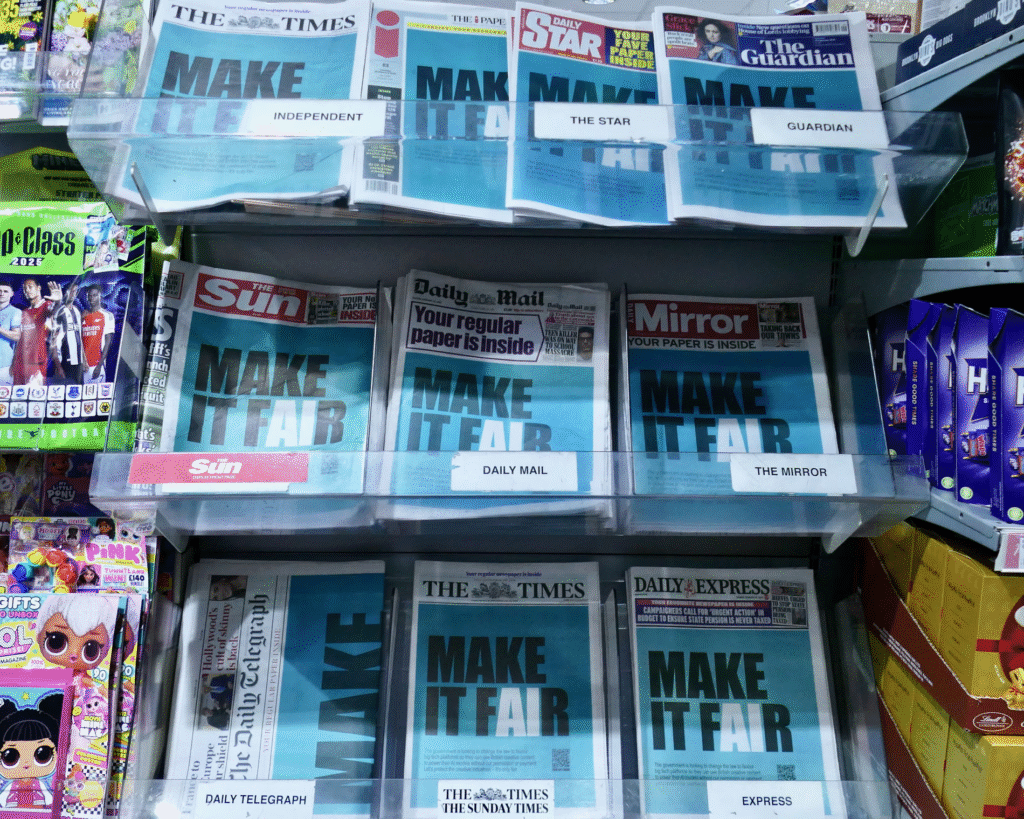
In February, the Make It Fair campaign highlighted the risks that generative AI poses to the creative industries.
Some publishers have negotiated licensing deals with AI companies, including the FT, Axel Springer, the Guardian, and Nordic publisher Schibsted with OpenAI, while others, such as the BBC, have pursued legal action over alleged copyright violations.
“It’s a two-pronged attack on publishers,” says Chris Duncan, former senior executive at News UK and Bauer Media. “Content is being absorbed into AI products without fair compensation, while AI summaries reduce the need for clicks, cutting revenue from both ends. It’s an existential crisis.”
Publishers are responding on multiple fronts: making deals, pursuing legal action, lobbying regulators, and integrating AI tools into their newsrooms. The Washington Post and FT have launched AI-powered chatbots, Climate Answers and Ask FT, that source information solely from their own content.
Christoph Zimmer, chief product officer at Germany’s Der Spiegel, notes that while traffic remains stable for now, he expects referrals from all platforms to decline. “This continues a longstanding trend,” he said. “It especially affects brands that haven’t built direct subscriptions and relied on platform reach or generic content. The principles that always mattered—quality content and human oversight—remain crucial.”
A publishing executive observes that the initial focus on licensing AI models to “learn English” is shifting toward live news delivery, a potentially lucrative market requiring accurate, real-time sources.
Saj Merali, CEO of the Periodical Publishers Association, stresses the need to balance tech-driven consumer habits with the fair value of trusted news. “AI requires reliable content,” she said. “Consumers are changing how they want to receive information, but they must trust what they read. The industry has been resilient through major digital changes, but currently, AI and tech companies show little support for sustaining publisher revenue.”